Readings:
Ecclesiastes 3:16-22
Psalm 115:1-8
Acts 20:17-28
Mark 8:27–30Preface of Apostles and Ordinations
[Common of a Martyr]
[Common of a Missionary]
[Common of a Pastor]
[Of the Holy Cross]
[For the Ministry II]
[For the Mission of the Church]
Pour out thy Holy Ghost, O God, upon thy church in every land, that like thy servant Boniface we might proclaim the Gospel unto all nations, that thy kingdom might be enlarged and that thy holy Name might be glorified in all the world; through Jesus Christ our Lord, who liveth and reigneth with thee and the same Holy Ghost, one God, for ever and ever. Amen.
PRAYER (contemporary language)
Pour out your Holy Spirit, O God, upon your church in every land, that like your servant Boniface we might proclaim the Gospel to all nations, that your kingdom might be enlarged and that your holy Name might be glorified in all the world; through Jesus Christ our Lord, who lives and reigns with you and the same Spirit, one God, for ever and ever. Amen.
Lessons revised in Lesser Feaxsts & Fasts 2024.
Return to Lectionary Home Page
Webmaster: Charles Wohlers
Last updated: 5 April 2025
BONIFACE
BISHOP, MISSIONARY, MARTYR (5 JUNE 754)
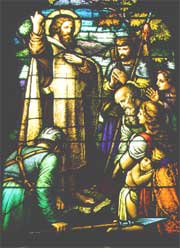 Wynfrith,
nicknamed Boniface ("good deeds"), was born around 680 near Crediton in
Devonshire, England. When he was five, he listened to some monks who were
staying at his father's house. They had returned from a mission to the
pagans on the continent, and Boniface was so impressed by them that he
resolved to follow their example. Although his father had intended him
for a secular career, he gave way to his son's entreaties and sent him
at the age of seven to a monastery school. He eventually became director
of the school at Nursling, in Winchester, where he wrote the first Latin
grammar in England, and gave lectures that were widely copied and circulated.
Wynfrith,
nicknamed Boniface ("good deeds"), was born around 680 near Crediton in
Devonshire, England. When he was five, he listened to some monks who were
staying at his father's house. They had returned from a mission to the
pagans on the continent, and Boniface was so impressed by them that he
resolved to follow their example. Although his father had intended him
for a secular career, he gave way to his son's entreaties and sent him
at the age of seven to a monastery school. He eventually became director
of the school at Nursling, in Winchester, where he wrote the first Latin
grammar in England, and gave lectures that were widely copied and circulated.
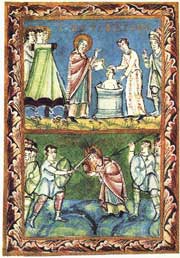 At
thirty, he was ordained and set out to preach in Friesland (overlaps with
modern Holland), whence he was soon expelled because of war between its
heathen king and Charles Martel of France. Boniface, after a brief withdrawal,
went into Hesse and Bavaria, having secured the support of the Pope and
of Charles Martel for his work there. In Hesse, in the presence of a large
crowd of pagans, he cut down the Sacred Oak of Geismar, a tree of immense
age and girth, sacred to the god Thor. It is said that after only a few
blows of his axe, the tree tottered and crashed to the ground, breaking
into four pieces and revealing itself to be rotted away within. It was
the beginning of a highly successful missionary effort, and the planting
of a vigorous Christian church in Germany, where Boniface was eventually
consecrated bishop. He asked the Christian Saxons of England to support
his work among their kinsmen on the continent, and they responded with
money, books, supplies, and above all, with a steady supply of monks to
assist him in teaching and preaching.
At
thirty, he was ordained and set out to preach in Friesland (overlaps with
modern Holland), whence he was soon expelled because of war between its
heathen king and Charles Martel of France. Boniface, after a brief withdrawal,
went into Hesse and Bavaria, having secured the support of the Pope and
of Charles Martel for his work there. In Hesse, in the presence of a large
crowd of pagans, he cut down the Sacred Oak of Geismar, a tree of immense
age and girth, sacred to the god Thor. It is said that after only a few
blows of his axe, the tree tottered and crashed to the ground, breaking
into four pieces and revealing itself to be rotted away within. It was
the beginning of a highly successful missionary effort, and the planting
of a vigorous Christian church in Germany, where Boniface was eventually
consecrated bishop. He asked the Christian Saxons of England to support
his work among their kinsmen on the continent, and they responded with
money, books, supplies, and above all, with a steady supply of monks to
assist him in teaching and preaching.
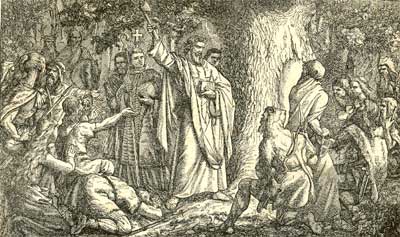 |
Boiniface felling the oak, from
an old German book of Saints |
Boniface did not confine his attentions to Germany. He worked to establish cooperation between the Pope and others in Italy on the one hand and Charles and his successors in France on the other. He persuaded Carloman and Pepin, the sons of Charles, to call synods for the reform of the church in their territories, where under previous rulers bishoprics had often been sold to the highest bidder. He never forgot his initial failure in Friesland, and in old age resigned his bishopric and returned to work there. Many Frisians had been converted earlier by Willibrord (another Saxon missionary from England--see 7 Nov), but had lapsed after his death. Boniface preached among them with considerable success. On June 5, the eve of Pentecost, 754, he was preparing a group of Frisians for confirmation when they were attacked and killed by heathen warriors.
The historian Christopher Dawson estimates that he has had a greater influence on the history of Europe than any other Englishman.