Readings:
2 Kings 2:19-25
Psalm 105:1-5
Acts 1:1-9
Luke 18:1-8Preface of Apostles and Ordinations
[Common of a Missionary]
[Common of a Pastor]
[For the Ministry II]
[For the Mission of the Church]
PRAYER (traditional language)
Pour out thy Holy Spirit, O God, upon thy church in every land, that like thy servant Willibrord we might proclaim the Gospel unto all nations, that thy kingdom might be enlarged and that thy holy Name might be glorified in all the world; through Jesus Christ our Lord, who liveth and reigneth with thee and the same Spirit, one God, for ever
and ever. Amen.
PRAYER (contemporary language)
Pour out your Holy Spirit, O God, upon your church in every land, that like your servant Willibrord we might proclaim the Gospel to all nations, that your kingdom might be enlarged and that your holy Name might be glorified in all the world; through Jesus Christ our Lord, who lives and reigns with you and the same Spirit, one God, for ever and ever. Amen.
Lessons revised at General Convention 2024.
Return to Lectionary Home Page
Webmaster: Charles Wohlers
Last updated: 7 Sept. 2024
WILLIBRORD OF UTRECHT
ARCHBISHOP AND MISSIONARY (NOV 7, 739)
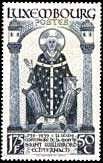 Willibrord,
first Archbishop of Utrecht, is one of the missionaries sent out by the
Anglo-Saxon Christians about a century after they had themselves been
Christianized by missionaries in the south and east of England from Rome
and the Continent, and in the north and west from the Celtic peoples of
Scotland, Ireland, and Wales.
Willibrord,
first Archbishop of Utrecht, is one of the missionaries sent out by the
Anglo-Saxon Christians about a century after they had themselves been
Christianized by missionaries in the south and east of England from Rome
and the Continent, and in the north and west from the Celtic peoples of
Scotland, Ireland, and Wales.
Our information about Willibrord comes to us from the
Venerable Bede (History of the English Church and People, v. 10-11)
and from a biography by his younger kinsman Alcuin (see 20 May), Minister
of Education under the Emperor Charlemagne. Willibrord was born in Northumbria
in England about 658, and studied in France and Ireland. In 690 he set
out with 12 companions to preach to the pagans of Frisia (a region roughly
coextensive with the province of Friesland in the Netherlands, including
some adjacent territories and the Frisian islands in the North Sea). His
work was interrupted several times by wars, and he left for a while to
preach to the Danes instead. He died 7 November 739.
Willibrord is a symbol of ties between the Christians
of England and those of Holland. Today the historic See of Utrecht is
in full communion with the Church of England.
by James Kiefer
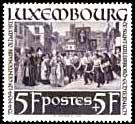
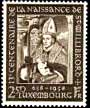
(These stamps honor Willibrord because of his founding of the Abbey at Echternach, in Luxemburg, and were used to aid renovations there.)