Readings:
Leviticus 19:32-37
Psalm 101:1-4
Acts 9:36–42
Matthew 25:1-13Preface of God the Son
PRAYER (traditional language)
Most Holy God, who didst raise from the dead thy servant Tabitha to display thy power and confirm that thy Son is Lord; Grant unto us thy grace, that, aided by her prayers and example, we may be given a new life in thee, to do works pleasing in thy sight; through Jesus Christ thy Son our Lord; who liveth and reigneth with thee, in the unity of the Holy Ghost, one God, for ever and ever. Amen.
PRAYER (contemporary language)
Most Holy God, who did raise from the dead your servant Tabitha to display your power and confirm that your Son is Lord; Grant unto us your grace, that, aided by her prayers and example, we may be given a new life in you, to do works pleasing in your sight; through Jesus Christ your Son our Lord; who lives and reigns with you, in the unity of the Holy Spirit, one God, for ever and ever. Amen.
Lessons revised at General Convention 2024
Return to Lectionary Home Page
Webmaster: Charles Wohlers
Last updated: 24 August 2024
DORCAS (TABITHA) OF JOPPA
CO-WORKER WITH THE APOSTLES, 25 OCT. NT
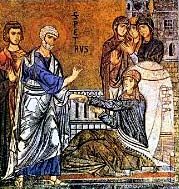 Dorcas
(or Tabitha in Aramaic -- both names mean "gazelle") is mentioned
in Acts 9:36-42. She was a member of the early Christian community in
Joppa, a seacoast town of Israel, and noted for her acts of charity, in
particular for making garments and giving them to needy widows. When she
fell ill and died, Peter came to see her, and raised her to life. His
words to her, "Tabitha, kumi," (Tabitha, arise), are reminiscent
of the words of Jesus to the daughter of Jairus, "Talitha, kumi,"
(little girl, arise) as given in Mark 5:41. Whether this is anything more
than coincidence is hard to say. If the Aramaic words of Jesus had been
quoted by Luke rather than by Mark, one might suppose that Luke was underscoring
a resemblance between the two episodes (the reader is invited to look
up both stories, the former in M 9:18-26 = P 5:22-43 = L 41-56 and the
latter in Acts 9:36-42). As it is, I am not sure that Luke (or Peter, presumably
Mark's source for his account) intends a connection.
Dorcas
(or Tabitha in Aramaic -- both names mean "gazelle") is mentioned
in Acts 9:36-42. She was a member of the early Christian community in
Joppa, a seacoast town of Israel, and noted for her acts of charity, in
particular for making garments and giving them to needy widows. When she
fell ill and died, Peter came to see her, and raised her to life. His
words to her, "Tabitha, kumi," (Tabitha, arise), are reminiscent
of the words of Jesus to the daughter of Jairus, "Talitha, kumi,"
(little girl, arise) as given in Mark 5:41. Whether this is anything more
than coincidence is hard to say. If the Aramaic words of Jesus had been
quoted by Luke rather than by Mark, one might suppose that Luke was underscoring
a resemblance between the two episodes (the reader is invited to look
up both stories, the former in M 9:18-26 = P 5:22-43 = L 41-56 and the
latter in Acts 9:36-42). As it is, I am not sure that Luke (or Peter, presumably
Mark's source for his account) intends a connection.
by James Kiefer