Readings:
Psalm 113:1-7
Jeremiah 34:8-18
Galatians 2:15-20
Mark 3:23-29Preface of Baptism
[Common of a Prophetic Witness]
[For Prophetic Witness in Society]
[For All Baptized Christians]
PRAYER (traditional language)
Gracious God, kindle in thy Church a zeal for justice and the dignity of all, that we, following the example of thy servant William Edward Burghardt Du Bois, may have the grace to defend all the oppressed and maintain the cause of those who have been silenced; through Jesus Christ our Lord, who liveth and reigneth with thee and the Holy Spirit, one God, now and for ever. Amen.
PRAYER (contemporary language)
Gracious God, kindle in your Church a zeal for justice and the dignity of all, that we, following the example of your servant William Edward Burghardt Du Bois, may have the grace to defend all the oppressed and maintain the cause of those who have been silenced; through Jesus Christ our Lord, who lives and reigns with you and the Holy Spirit, one God, now and for ever. Amen.
This commemoration appears in A Great Cloud of Witnesses.
Return to Lectionary Home Page
Webmaster: Charles Wohlers
Last updated: 6 June 2020
W. E. B. DU BOIS
SOCIOLOGIST, 3 August 1963
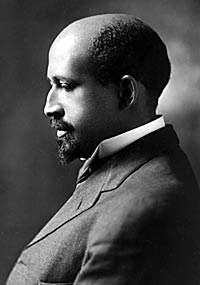 William Edward Burghardt Du Bois. February 23, 1868 – August 27, 1963) was an American civil rights activist, Pan-Africanist, sociologist, historian, author, and editor. Historian David Levering Lewis wrote, "In the course of his long, turbulent career, W. E. B. Du Bois attempted virtually every possible solution to the problem of twentieth-century racism— scholarship, propaganda, integration, national self-determination, human rights, cultural and economic separatism, politics, international communism, expatriation, third world solidarity."
The first African-American graduate of Harvard University, where he earned his Ph.D in History, Du Bois later became a professor of history and economics at Atlanta University. He became the head of the National Association for the Advancement of Colored People (NAACP) in 1910, becoming founder and editor of the NAACP's journal The Crisis. Du Bois rose to national attention in his opposition of Booker T. Washington's ideas of social integration between whites and blacks, campaigning instead for increased political representation for blacks in order to guarantee civil rights, and the formation of a Black elite that would work for the progress of the African American race.
W. E. B. Du Bois was involved in religion, studied Baptist churches, and contributed to the sociological study of religion. Du Bois said that church “introduces the stranger to the community, it serves as a lyceum, library, and lecture bureau—it is, in fine, the central organ of the organized life of the American Negro.”
Susan Jacoby writes that Du Bois was "raised as a liberal New England Congregationalist...contrary to the majority of blacks, who were brought up in the Baptist evangelical tradition". Du Bois' polemical stance on prayer in school and his critical views on the church set him at odds with contemporary Booker T. Washington.
Du Bois wrote many books, including three major autobiographies. Among his most significant works are The Philadelphia Negro (1899), The Souls of Black Folk (1903), John Brown (1909), Black Reconstruction (1935), and Black Folk, Then and Now (1939). His book The Negro (1915) influenced the work of several pioneer Africanist scholars.
from Wikipedia