Readings:
Preface of Trinity Sunday
[Common of a Theologian and Teacher]
[Common of a Monastic or Professed Religious]
[Of the Holy Trinity]
PRAYER (traditional wording)
Almighty God, who hast enriched thy Church with the singular
learning and holiness of thy servant Thomas Aquinas: Enlighten us more
and more, we pray, by the disciplined thinking and teaching of Christian
scholars, and deepen our devotion by the example of saintly lives; through
Jesus Christ our Lord, who liveth and reigneth with thee and the Holy
Spirit, one God, for ever and ever. Amen.
PRAYER (contemporary wording)
Almighty God, who has enriched your Church with the
singular learning and holiness of your servant Thomas Aquinas: Enlighten
us more and more, we pray, by the disciplined thinking and teaching of
Christian scholars, and deepen our devotion by the example of saintly
lives; through Jesus Christ our Lord, who lives and reigns with you and
the Holy Spirit, one God, for ever and ever. Amen.
Lessons revised at General Convention 2024.
Return to Lectionary Home Page
Webmaster: Charles Wohlers
Last updated: 30 Nov. 2024
THOMAS AQUINAS
PRIEST, FRIAR, AND THEOLOGIAN (28 JAN 1274)
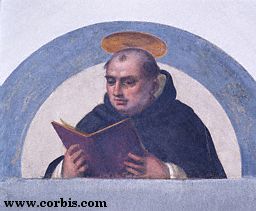 In
the thirteenth century, when Thomas Aquinas lived, the works of
Aristotle, largely forgotten in Western Europe, began to be available
again, partly from Eastern European sources and partly from Moslem Arab
sources in Africa and Spain. These works offered a new and exciting way
of looking at the world. Many enthusiastic students of Aristotle adopted
him quite frankly as as an alternative to Christianity. The response of
many Christians was to denounce Aristotle as an enemy of the Christian
Faith. A third approach was that of those who tried to hold both Christian
and Aristotelian views side by side with no attempt to reconcile the two.
Aquinas had a fourth approach. While remaining a Christian, he immersed
himself in the ideas of Aristotle, and then undertook to explain Christian
ideas and beliefs in language that would make sense to disciples of Aristotle.
At the time, this seemed like a very dangerous and radical idea, and Aquinas
spent much of his life living on the edge of ecclesiastical approval.
His success can be measured by the prevalence today of the notion that
of course all Christian scholars in the Middle Ages were followers
of Aristotle.
In
the thirteenth century, when Thomas Aquinas lived, the works of
Aristotle, largely forgotten in Western Europe, began to be available
again, partly from Eastern European sources and partly from Moslem Arab
sources in Africa and Spain. These works offered a new and exciting way
of looking at the world. Many enthusiastic students of Aristotle adopted
him quite frankly as as an alternative to Christianity. The response of
many Christians was to denounce Aristotle as an enemy of the Christian
Faith. A third approach was that of those who tried to hold both Christian
and Aristotelian views side by side with no attempt to reconcile the two.
Aquinas had a fourth approach. While remaining a Christian, he immersed
himself in the ideas of Aristotle, and then undertook to explain Christian
ideas and beliefs in language that would make sense to disciples of Aristotle.
At the time, this seemed like a very dangerous and radical idea, and Aquinas
spent much of his life living on the edge of ecclesiastical approval.
His success can be measured by the prevalence today of the notion that
of course all Christian scholars in the Middle Ages were followers
of Aristotle.
 Aristotle
is no longer the latest intellectual fashion, but Aquinas's insistence
that the Christian scholar must be prepared to meet other scholars on
their own ground, to become familiar with their viewpoints, to argue from
their premises, has been a permanent and valuable contribution to Christian
thought.
Aristotle
is no longer the latest intellectual fashion, but Aquinas's insistence
that the Christian scholar must be prepared to meet other scholars on
their own ground, to become familiar with their viewpoints, to argue from
their premises, has been a permanent and valuable contribution to Christian
thought.
Some Christian scholars today are undertaking, with varying degrees of success, to
explore the relations between Christianity and various contemporary studies or
world-outlooks that have been used as weapons by opponents of Christianity. Examples that
come to mind include the following:
William G Pollard, Anglican priest, nuclear physicist
at the Oak Ridge Laboratory (government-connected), Executive Director
of the Oak Ridge Institute for Nuclear Studies (not government-connected),
and author of Chance and Providence and Physicist
and Christian.
John Polkinghorne, FRS, Anglican priest, head of Queen's
College, Cambridge, nuclear physicist, and author of Science
and Creation, Science
and Providence, and various other works, including most recently
The
Faith of a Physicist. (For non-scientists, I will point out that "FRS"
denotes a Fellow of the Royal Society, a member of the elite of British
scientists.)
G B Sanders, author of Christianity
after Freud. (For a brief summary of his thesis, consult the Christia
Web page.
Various writers on "liberation theology" who have
undertaken to show that Marxism, properly interpreted, does not imply the falsity of
Christianity.
by James Kiefer