Readings:
Ecclesiasticus 29:1-9
Psalm 39:4-8
1 John 2:15-17
Mark 2:23-28Preface of a Saint (2)
[Common of a Monastic or Professed Religious]
[Of the Holy Trinity]
PRAYER (traditional language)
O God, whose blessed Son became poor that we, through his poverty, might
be rich: Deliver us, we pray thee, from an inordinate love of this world,
that inspired by the devotion of thy servant Sergius, we may
serve thee with singleness of heart, and attain to the riches of the age
to come; through the same Jesus Christ our Lord, who liveth and reigneth
with thee and the Holy Spirit, one God, now and for ever.
Amen.
PRAYER (contemporary language)
O God, whose blessed Son became poor that we, through his poverty, might
be rich: Deliver us from an inordinate love of this world, that we, inspired
by the devotion of your servant Sergius, may serve you with
singleness of heart, and attain to the riches of the age to come; through
Jesus Christ our Lord, who lives and reigns with you and the Holy Spirit,
one God, for ever and ever. Amen.
Lessons revised at Gneral Convention 2024
Return to Lectionary Home Page
Webmaster: Charles Wohlers
Last updated:
27 July 2024
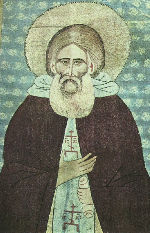
SERGIUS OF RADONEZH
ABBOT OF HOLY TRINITY (25 SEPT 1392)
To the people of Russia, Sergius is a national hero and an example of
Russian spiritual life at its best.
 Sergius
was born around 1314, the son of a farmer. When he was twenty, he and
his brother began to live as hermits in a forest near Moscow. Others joined
them in what became the Monastery of the Holy Trinity, a center for the
renewal of Russian Christianity. Pilgrims came from all Russia to worship
and to receive spiritual instruction, advice, and encouragement. The Russians
were at the time largely subservient to the neighboring (non-Christian)
Tatar (or Tartar) people. Sergius rallied the people behind Prince Dimitri
Donskoi, who defeated the Tatars in 1380 and established an independent
Russia.
Sergius
was born around 1314, the son of a farmer. When he was twenty, he and
his brother began to live as hermits in a forest near Moscow. Others joined
them in what became the Monastery of the Holy Trinity, a center for the
renewal of Russian Christianity. Pilgrims came from all Russia to worship
and to receive spiritual instruction, advice, and encouragement. The Russians
were at the time largely subservient to the neighboring (non-Christian)
Tatar (or Tartar) people. Sergius rallied the people behind Prince Dimitri
Donskoi, who defeated the Tatars in 1380 and established an independent
Russia.
Sergius was a gentle man, of winning personality. Stories told of him resemble those of Francis of Assisi, including some that show that animals tended to trust him. He had the ability to inspire in men an intense awareness of the love of God, and a readiness to respond in love and obedience. He remained close to his peasant roots. One contemporary said of him, "He has about him the smell of fir forests." To this day, the effect of his personality on Russian devotion remains considerable.
(The following material is taken with minor alterations from The Lives of the Saints, by Sabine Baring-Gould, author of the hymn "Onward, Christian Soldiers. The reader will note that this account was written before the Communist Revolution, at a time when the Czar was still ruler of Russia, and the Russian Orthodox Church was the official religion of the country.)
The name of Sergius is as dear to every Russian's heart as that of William
Tell to a Swiss, or that of Joan of Arc to a Frenchman. He was born at
Rostoff in the early part of the 14th century, and when quite young left
the house of his parents, and, together with his brother Stephen, settled
himself in the dense forests of Radonege with bears for his companions,
suffering from fierce cold in winter, often from famine. The fame of his
virtues drew disciples around him. They compelled him to go to Peryaslavla-Zalessky,
to receive priestly orders from Athanasius, Bishop of Volhynia, who lived
there. Sergius built by his own labor in the midst of the forest a rude
church of timber, by the name of the Source of Life, the Ever Blessed
Trinity, which has since grown into the greatest, most renowned and wealthy
monastery in all Russia--the Troitzka (=Trinity) Abbey, whose destiny
has become inseparable from the destinies of the capital.
Princes and prelates applied to Sergius not only for
advice, but also for teachers trained in his school, who might become
in their realms and dioceses the heads of similar institutions, centers
whence light and wisdom might shine. Tartar invasion had quenched the
religious fervor of the Russians: a new era of zeal opened with the foundation
of the Troitzka monastery and the labors of Sergius. At the request of
Vladimir, Athanasius, a disciple of Sergius, founded the Visotsky monastery
at Serpouchoff; and another of his pupils, Sabbas, laid the foundation
of the convent of Svenigorod, while his nephew Theodore laid that of Simonoff
in Moscow. In the terrible struggle against the Tartars, the heart of
the Grand-Prince Demetrius failed him; how could he break the power of
this inexhaustible horde which, like the locusts of the prophet Joel,
had the garden of Eden before them and left behind them a desolate wilderness?
It was the remonstrance, the prayers of Sergius, that encouraged the Prince
to engage in battle with the horde on the fields of the Don. No historical
picture or sculpture in Russia is more frequent than that which represents
the youthful warrior receiving the benediction of the aged hermit. Two
of his monks, Peresvet and Osliab, accompanied the Prince to the field,
and fought in coats of mail drawn over their monastic habit; and the battle
was begun by the single combat of Peresvet with a gigantic Tartar, champion
of the Horde.
The two chief convents in the suburbs of Moscow still
preserve the recollection of that day. One is the vast fortress of the
Donskoi monastery, under the Sparrow Hills. The other is the Simonoff
monastery already mentioned, founded on the banks of the Mosqua, on a
beautiful spot chosen by the saint himself, and its earliest site was
consecrated by the tomb which covers the bodies of his two warlike monks.
From that day forth he stood out in the national recollection as the champion
of Russia. It was from his convent that the noblest patriotic inspirations
were drawn, and, as he had led the way in giving the first great repulse
to the Tartar power, so the final blow in like manner came from a successor
in his place. In 1480, when Ivan III wavered, as Demetrius had wavered
before him, it was by the remonstrance of Archbishop Bassian, formerly
prior of the Troitzka monastery, that Ivan too was driven, almost against
his will, to the field. "Dost thou fear death?" so he was addressed by
the aged prelate. "Thou too must die as well as others; death is the lot
of all, man, beast, and bird alike; none avoid it. Give these warriors
into my hands, and, old as I am, I will not spare myself, nor turn my
back upon the Tartars." The Metropolitan, we are told, added his exhortations
to those of Bassian. Ivan returned to the camp, the Khan of the Golden
Horde fled without a blow, and Russia was set free for ever. [Note:
The reader will remember that Constantinople (also called New Rome) fell
to the Turks in 1453, and thus the Byzantine or Eastern Roman Empire came
to an end. This same Ivan III married the niece of the last Byzantine
Emperor, and so claimed for himself a position in the line of Christian
Emperors beginning with Constantine, and for Moscow the position of Third
Rome, the capital thenceforth of the Christian world.]
Now back to the time of Sergius.
The Metropolitan, Alexis, being eighty-four years old,
perceived that his end was approaching, and he wished to give Sergius
his blessing and appoint him as his successor. But the humble monk, in
great alarm, declared that he could not accept and wear the sacred picture
of the Blessed Virgin suspended by gold chains, which the primate had
sent him from his own breast on which it had hung. "From my youth up,"
said he, "I have never possessed or worn gold, and how now can I adorn
myself in my old age?" St. Sergius died at an extremely advanced age in
1392, amidst the lamentations of his contemporaries.