Readings:
Tobit 6:1-6
Psalm 15
Titus 2:7-8
Mark 13:32-37Preface of a Saint (2)
PRAYER (traditional language)
Holy God, who didst endow thy servant Hugh of Lincoln with wise and cheerful boldness, and taught him to commend the discipline of holy life to kings and princes: Grant that we also, rejoicing in the Good News of thy mercy, and fearing nothing but the loss of thee, may be bold to speak the truth in love, in the name of Jesus Christ our Redeemer; who liveth and reigneth with thee and the Holy Ghost, one God, for ever and ever. Amen.
PRAYER (contemporary language)
Holy God, who endowed your servant Hugh of Lincoln with wise and cheerful boldness, and taught him to commend the discipline of holy life to kings and princes: Grant that we also, rejoicing in the Good News of your mercy, and fearing nothing but the loss of you, may be bold to speak the truth in love, in the name of Jesus Christ our Redeemer; who lives and reigns with you and the Holy
Spirit, one God, for ever and ever. Amen.
Lessons revised at General Convention 2024.
Return to Lectionary Home Page
Webmaster: Charles Wohlers
Last updated: 21 Sept. 2024
HUGH OF LINCOLN
BISHOP, PROTECTOR OF THE OPPRESSED (17 NOV
1200)
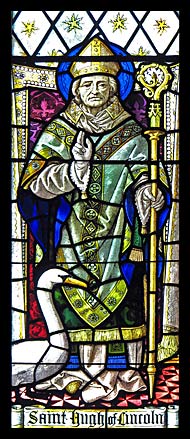 photo courtesy Br. Lawrence Lew, OP |
On his arrival in England in 1176, Hugh found that the building of the
monastery had not begun. Worse, no compensation had been paid to those
who would have to lose their lands and property to make room for it. Hugh
refused to take office until these persons had been paid "to the last penny."
He intervened again on behalf of the builders, whose pay was not forthcoming.
Henry loved him for his plain speaking. "I do not
despair of you," Hugh said to him at their first interview; "I know how
much your many occupations interfere with the health of your soul." Henry,
impressed by his frankness, swore that while he lived he should not leave
his kingdom, and took so much pleasure in his conversation, and paid so
much heed to his counsels, that a rumor arose that Hugh was his son. Hugh's
biographer wrote that "of all men only Hugh could bend that rhinosceros
to his will." When Henry was in danger of shipwreck, he cried out, "If
only my Carthusian Hugh were awake and at prayer, God would not forget
me." This affection never diminished, though Hugh dared to oppose the king,
particularly in the matter of keeping bishoprics vacant in order that their
revenues might fall to the king's treasury. One of the worst examples was
Lincoln, which, except for a few months, had been without a bishop for
eighteen years. Hugh was elected to the post in 1186, and his monastic
superiors ordered him to accept. After so long a period of neglect, there
was great need of reform. Hugh employed priests of great piety and learning,
and made the fullest use of his authority in disciplining his clergy. He
took a stern view of the ill-treatment of the poor by the royal foresters,
and when a subject of the church of Lincoln suffered at their hands he
excommunicated their chief.
He also refused to appoint a royal favorite to a
meaningless but lucrative post. Henry was furious, and summoned him to
his presence. He came, and Henry turned away his face and would not speak,
but by way of ignoring his presence took out a torn glove and began to
sew it. At last Hugh said, "How like you are to your relations at Falaise."
The king might have resented this allusion to the humble birth of William
the Conqueror's mother, the daughter of a glove-maker, but he only laughed,
and the quarrel was made up.
Riots against the Jews broke out in England at the time of the Third
Crusade. In defence of the persecuted, Hugh faced armed mobs in Lincoln,
Stamford and Northampton and compelled their submission. Hugh refused to
raise money for the foreign wars of King Richard the Lion-Heart, calmed
the king's rage with a kiss, and persisted in his refusal: this was the
first clear example on record of the refusal of a money-grant demanded
directly by the crown, and an important legal precedent. Richard said,
"If all bishops were like my lord of Lincoln, not a prince among us could
raise his head against them."
His relations with King John were less happy. John
showed him an amulet, which he said was sacred and would preserve him.
Hugh replied, "Do not put your trust in lifeless stone, but only in the
living and heavenly stone, our Lord Jesus Christ." The following Easter
he preached at length on the duties of kings, and the king slipped out
partway through.
Devout, tireless, and forgetful of self, Hugh also had wit, a temper
that he described as "more biting than pepper," and a great love and concern
for children and the defenceless. He visited leper-houses and washed the
ulcerous limbs of their inmates. He was fond of animals, and they of him.
Birds and squirrels came readily to his hand. He had a swan that would
feed from his hand, follow him about, and keep guard over his bed, so that
no one could approach it without being attacked.
In 1200 the king sent him on an embassy to France.
His mission was a success, but he took ill and returned to England to die
on 16 November 1200. John Ruskin called him "the most beautiful sacerdotal
(priestly) figure known to me in history."