Readings:
Psalm 144:9-15
Wisdom 9:7-12
1 Timothy 4:6-10
Luke 10:21-24Preface of a Saint (1)
[Common of a Missionary]
[Common of a Saint]
[For All Baptized Christians]
[For the Mission of the Church]
PRAYER (traditional language)
God of Creation, who didst mold humanity from the fertile earth: Grant that we, following the good examples of Queen Bertha and King Ethelbert, may gladly receive and fruitfully nurture the seed of the Gospel to the bounty of thy kingdom; through Jesus Christ our Lord, who with thee and the Holy Spirit liveth and reigneth, one God, now and for ever. Amen.
PRAYER (contemporary language)
God of Creation, who molded humanity from the fertile earth: Grant that we, following the good examples of Queen Bertha and King Ethelbert, may gladly receive and fruitfully nurture the seed of the Gospel to the bounty of your kingdom; through Jesus Christ our Lord, who with you and the Holy Spirit lives and reigns, one God, now and for ever. Amen.
This commemoration appears in A Great Cloud of Witnesses
Return to Lectionary Home Page
Webmaster: Charles Wohlers
Last updated: 30 March 2019
BERTHA and ETHELBERT
QUEEN & KING OF KENT, 616
Bertha or Aldeberge (539 – c. 612) was the Queen of Kent whose influence led to the introduction of Christianity to Anglo-Saxon England. She was canonized as a saint for her role in its establishment during that period of English history.
Bertha was the daughter of Charibert I, Merovingian King of Paris. When she married the pagan King Æthelberht of Kent, she brought her chaplain, Liudhard, with her to England. She restored a Christian church in Canterbury, which dated from Roman times, dedicating it to Saint Martin of Tours. The present St Martin's at Canterbury occupies the same site. Augustine of Canterbury, whose mission was sent by Pope Gregory I to preach the Gospel in England in 596, owed much of his favorable reception to the influence of Bertha.
— from Wikipedia
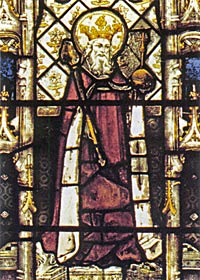 Æthelberht (also Æthelbert, Aethelberht, Aethelbert, or Ethelbert) (c. 560 – 24 February 616) was King of Kent from about 580 or 590 until his death. In his Ecclesiastical History of the English People, the monk Bede lists Aethelberht as the third king to hold imperium over other Anglo-Saxon kingdoms. In the late ninth century Anglo-Saxon Chronicle Æthelberht is referred to as a bretwalda, or "Britain-ruler". He was the first English king to convert to Christianity.
The native Britons had converted to Christianity under Roman rule. The Anglo-Saxon invasions separated the British church from European Christianity for centuries, so the church in Rome had no presence or authority in Britain, and in fact, Rome knew so little about the British church that it was unaware of any schism in customs. Æthelberht, however, would have known something about the Roman church from his Frankish wife, Bertha, who had brought a bishop, Liudhard, with her across the Channel. Æthelberht had a chapel built for her.
In 596, Pope Gregory the Great sent Augustine, prior of the monastery of St. Andrew in Rome, to England as a missionary, and in 597, a group of nearly forty monks, led by Augustine, landed on the Isle of Thanet in Kent. According to Bede, Æthelberht was sufficiently distrustful of the newcomers to insist on meeting them under the open sky, to prevent them from performing sorcery. The monks impressed Æthelberht, but he was not converted immediately. He agreed to allow the mission to settle in Canterbury and permitted them to preach.
It is not known when Æthelberht became a Christian. At the latest, Æthelberht must have converted before 601, since that year Gregory wrote to him as a Christian king. An old tradition records that Æthelberht converted on 1 June [Pentecost that year], in the summer of the year that Augustine arrived.
Through Æthelberht’s influence Sæberht, king of Essex, also was converted, but there were limits to the effectiveness of the mission. The entire Kentish court did not convert: Eadbald, Æthelberht’s son and heir, was a pagan at his accession. Rædwald, king of East Anglia, was only partly converted (apparently while at Æthelberht’s court), and retained a pagan shrine next to the new Christian altar. Augustine also was unsuccessful in gaining the allegiance of the British clergy.
Æthelberht’s code of laws for Kent, the earliest written code in any Germanic language, instituted a complex system of fines.
Æthelberht later was canonized for his role in establishing Christianity among the Anglo-Saxons, as were his wife and daughter.
— more at Wikipedia